

By Staff Reporter
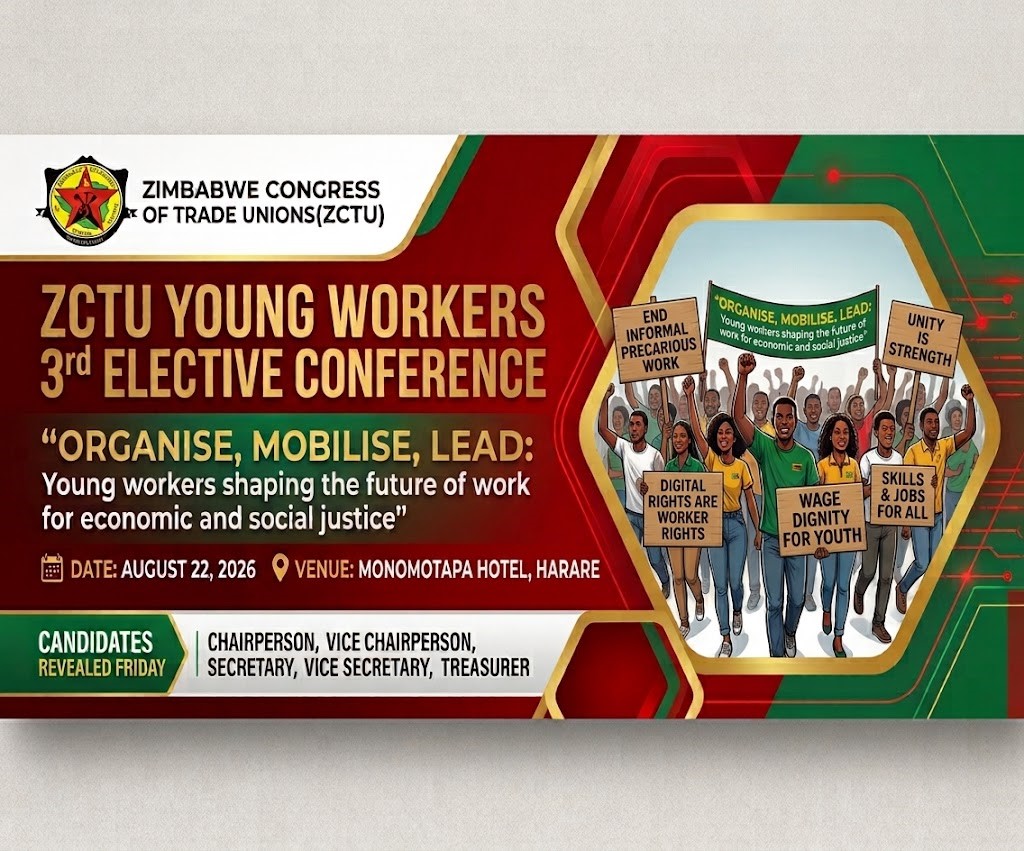
The Zimbabwe Congress of Trade Unions (ZCTU) National Young Workers Committee is set to hold its 3rd National Young Workers Conference on 22 August in Harare, with leadership elections and the future of young-worker organising expected to dominate proceedings.
The conference will be held under the theme “ORGANISE, MOBILISE, LEAD: Young workers shaping the future of work for economic and social justice.”
The theme burdens the Conference not to be merely an electoral gathering; it is an opportunity to define what young-worker trade unionism must look like in Zimbabwe in 2026 and beyond.
Delegates will elect a five-member executive comprising the Chairperson, Vice Chairperson, Secretary, Vice Secretary and Treasurer. Each affiliate union will then second a councillor to form the full executive committee. The final list of candidates is expected to be known on Friday following a meeting of the ZCTU Credentials Committee, which will verify nominations against the constitutional provisions governing the elections.
So far, two candidates have expressed interest in contesting the Chairperson's position. Wesley Gatsi of RAE, the current Vice Secretary, is expected to face Theophilus Kimbini of ESWUZ, although the possibility of additional candidates expressing interests in the race remains open until the nominations are formally verified.
Beyond the leadership contest, the conference comes at a critical time for young workers in Zimbabwe, who continue to face unemployment, underemployment, rising living costs, skills gaps and growing uncertainty over the future of work.
Young workers are also increasingly concentrated in informal and precarious forms of employment, including vending, casual labour, construction, transport, cross-border trading and other forms of self-employment. This presents a major organising challenge for traditional trade-union structures.
The rapid growth of the digital economy is adding another dimension. Remote work, freelancing, artificial intelligence, mobile money and technology-driven businesses are creating new opportunities for young Zimbabweans, while also raising concerns about job displacement, and social protection of workers in emerging forms of employment.
Climate change and just transition are also expected to feature prominently in discussions around the future of young workers. The cost of living remains another major concern. Housing, transport, healthcare, food and connectivity continue to mount pressure on workers, particularly those entering the labour market on low or unstable incomes.
Against this background, the incoming Young Workers executive will face the difficult task of turning the conference's theme into practical organising strategies. The challenge will be to move beyond seeing young workers simply as the future of the trade-union movement and instead recognise them as an active force in unionism today.
“Young workers are not only the future of trade unionism; they are the pulse of unionism,” a key message emerging ahead of the conference suggests, underscoring the need for sustained recruitment, mobilisation and meaningful participation of young workers in trade-union structures.
The new leadership will also be expected to develop young-worker leadership, strengthen workplace organising and find ways of reaching workers in the informal and emerging sectors of the economy. With Zimbabwe's labour market undergoing significant changes, the conference presents an opportunity for the ZCTU Young Workers to define a new organising agenda that responds to the realities of a younger generation.
The contest should therefore be viewed not simply as a competition between individuals, but as a choice about the organising direction and priorities of the Young Workers structure.
While the conference may determine who steers the leadership, the most important question facing the conference is: How does ZCTU organise a generation of young workers whose experience of work is increasingly informal, precarious, digital, mobile and disconnected from traditional trade-union structures?
The grand test for the incoming executive will be whether it can translate “Organise, Mobilise, Lead” from a conference theme into a sustained programme capable of giving young workers a stronger voice in Zimbabwe's labour movement and in shaping the future of work.





Leave a comment