

By Staff Reporter
Zimbabwe’s education sector has opened the third term amid growing concern over the welfare of teachers, with the Zimbabwe Teachers’ Association (ZIMTA) and the Amalgamated Rural Teachers Union of Zimbabwe (ARTUZ) issuing separate but closely aligned warnings over salaries, working conditions and the sustainability of the education system.
While the two unions differ in their immediate tactics, both say Government must urgently address the deteriorating economic conditions facing teachers if schools are to provide quality and uninterrupted learning.
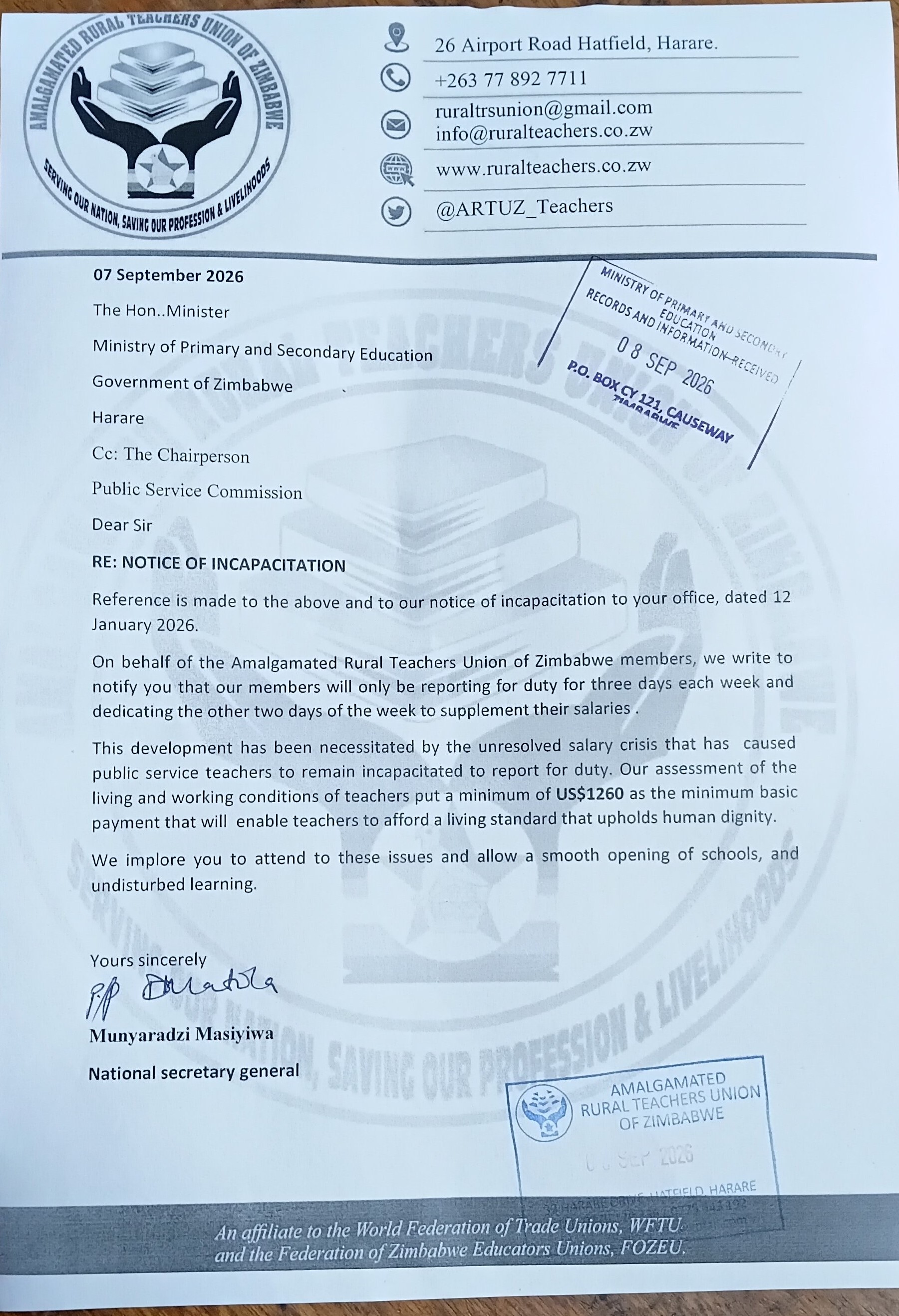
While ZIMTA has called for urgent negotiations and Government intervention, ARTUZ has escalated the dispute by formally notifying the Ministry of the incapacitation of teachers.
Under the position announced by the union, teachers will report for duty for three days a week, while using the remaining two days for supplementary income-generating activities to sustain their families.
ARTUZ maintains that the move is a direct consequence of the unresolved salary crisis and insists that teachers cannot continue working full-time on remuneration that does not provide a living wage.
The union has put forward US$1,260 as the minimum basic salary required to restore teachers’ dignity and enable them to meet basic household needs.
ARTUZ has stressed that the position should not be interpreted as an abandonment of education, but as a warning about the consequences of prolonged wage erosion.
The two positions have brought the teachers’ welfare question firmly back onto the national agenda as schools reopen.
ZIMTA welcomed the Ministry of Primary and Secondary Education’s circular announcing the opening of schools on 8 September, particularly its emphasis on inclusive education, protection of learning time, collective responsibility among stakeholders and fair policies on school uniforms.
However, the union said the circular had failed to adequately address teacher welfare, arguing that salaries, incentives, allowances for special responsibilities and working conditions were critical to the successful running of schools.
ZIMTA called on the Ministry and Treasury to take urgent measures to improve teachers’ remuneration at the beginning of the term.
The union also warned that teachers were under increasing pressure to implement the heritage-based curriculum while simultaneously preparing learners for public examinations.
The third term is particularly demanding, with Grade 7, O-Level and A-Level examinations placing additional pressure on teachers and schools.
ZIMTA said the demands could only be met if schools were provided with adequate resources and manageable class sizes.
The union further raised concerns over the implementation of inclusive education, saying the inclusion of children with disabilities and returning migrants must be accompanied by specialist training, infrastructure and support.
Without such resources, the union argued, schools were being handed responsibilities without the funding and personnel required to fulfil them.
Despite the differences between the unions, their statements reveal significant common ground. Both are effectively arguing that the quality of education cannot be separated from the welfare of educators.
A teacher struggling to pay for food, accommodation, transport and other basic necessities is expected to enter the classroom, prepare learners for examinations, implement curriculum reforms and undertake additional responsibilities.
For teachers in rural and underserved areas, the challenge is compounded by long distances to schools and inadequate transport. ZIMTA has called for targeted and subsidised transport support for teachers and pupils in such areas.
The union has also highlighted the difficulties created when teachers and school heads are expected to enforce payment of school fees and levies from parents who are themselves facing economic hardship.
At the heart of the dispute is the question of social dialogue. ZIMTA has urged the Ministry to engage directly with teacher unions rather than through proxies, arguing that genuine engagement is necessary to resolve problems affecting the education sector. ARTUZ's incapacitation strategy, meanwhile, demonstrates the consequences when negotiations fail to produce a sustainable solution. The growing divide between teachers' earnings and the cost of living risks creating a cycle of disputes in which each new school term begins with uncertainty over teacher participation.
For Government, the challenge is therefore bigger than getting teachers into classrooms. It must create conditions that enable them to remain in the profession, work effectively and provide quality education without having to rely on supplementary income simply to survive.




Leave a comment