

|
Student Number |
Student Number 227130091 Vimbai Eva Zinyama Mushongera |
|
Course |
Political Economy: Africa Debt & Economic Justice S7057T |
|
Tutor |
Professor Patrick Bond |
|
Assignment |
OPED Assignment : |
|
Threshold |
Deadline: 5 August 2026 |
The Paretian Capital Market Trap: Why Zimbabwe's Workers Grow Poorer While the Economy Grows
"There is nothing so useless as doing efficiently that which should not be done at all." — Peter Drucker
For more than three decades, African governments have pursued economic reforms intended to improve efficiency, attract investment, liberalize markets, and accelerate growth. By conventional economic indicators, many of these reforms appear successful. Gross Domestic Product (GDP) has expanded across several countries, mineral exports have increased, remittances from the diaspora have reached record levels, and governments have attracted unprecedented levels of foreign investment and sovereign lending. Yet beneath these encouraging statistics lies a stubborn reality. Unemployment remains persistently high. Informality has become the dominant source of livelihoods. Manufacturing continues to contract relative to First industries. Poverty and inequality remain entrenched, while periodic episodes of social tension—from Operation Murambatsvina in Zimbabwe to recurrent xenophobic attacks and Operation Dudula in South Africa—have increasingly targeted those who are themselves victims of exclusion rather than the institutions that reproduce it.
This paradox raises an uncomfortable question. How can economies become wealthier while their societies struggle to become more prosperous? Why do countries endowed with abundant natural resources, growing GDP, expanding debt portfolios and increasing remittance inflows continue to experience structural unemployment, weak industrialization and persistent poverty?
This article argues that the answer lies not in the absence of capital but in the philosophy guiding its allocation. It introduces the concept of the Paretian Capital Market Trap—not as a reference to Pareto efficiency in welfare economics, but as a description of how Pareto-inspired managerial principles have gradually migrated from the corporate boardroom into national development policy. Modern management rightly values productivity, optimization, return on investment, cost minimization, profitability, shareholder value, and competitive advantage because these tools improve the performance of firms. Within the corporation, they are indispensable. The problem begins when these same managerial tools become the dominant criteria by which governments evaluate national development.
A corporation and a nation are fundamentally different institutions. The objective of a firm is to maximise value for its owners; the objective of a developmental state is to expand opportunities, productive capabilities and shared prosperity for all its citizens. Yet contemporary development policy increasingly evaluates national success through the same metrics used to evaluate corporate performance. Labour is treated primarily as a production cost rather than a productive capability. Education becomes a recurrent expenditure rather than a long-term investment in innovation. Health is viewed as fiscal consumption instead of productive infrastructure. Informal enterprises are regarded as market distortions rather than incubators of entrepreneurship. Public investment is judged by short-term financial returns rather than its contribution to structural transformation. In effect, national development has become increasingly managed as though it were a corporate balance sheet.
This managerial logic helps explain why African economies can record impressive macroeconomic achievements without achieving genuine transformation. Capital markets are not malfunctioning. They are doing precisely what they were designed to do: allocate capital to activities that promise the highest financial returns. Extractive industries, speculative finance and capital-intensive investments naturally outperform labour-intensive manufacturing, small enterprises and local value chains when measured solely by financial efficiency. The consequence is an economy capable of producing higher GDP without producing sufficient employment, exporting more minerals without building domestic industry, borrowing more without strengthening productive capacity, and receiving billions in remittances without converting them into industrial investment.
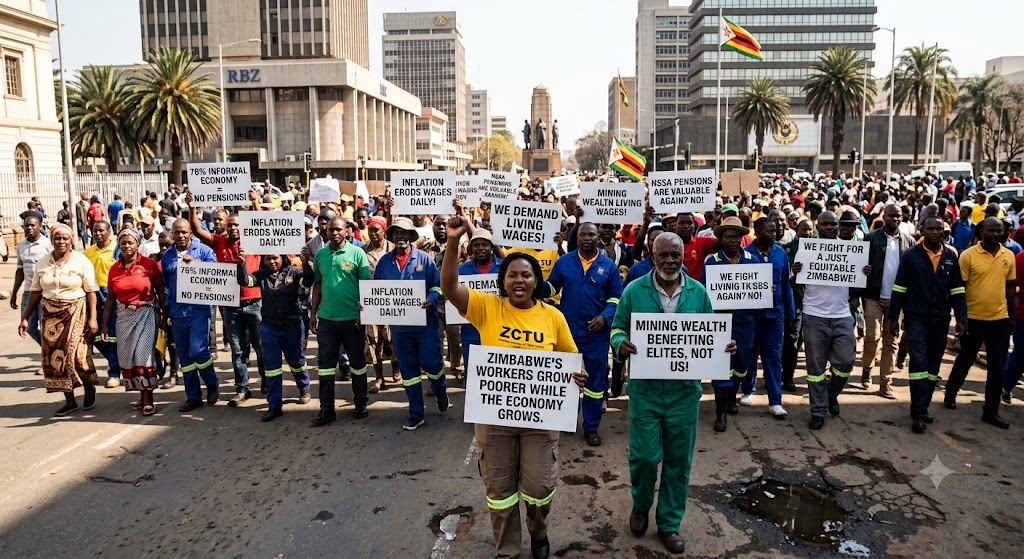
Zimbabwe illustrates this paradox with remarkable clarity. Despite successive investment promotion strategies, mining expansion and repeated declarations that the country is "open for business", employment growth has remained weak and overwhelmingly informal. More than four out of every five workers now earn their livelihoods in the informal economy, where incomes are low, social protection is limited, occupational safety standards are often absent, and collective bargaining is largely unavailable. At the same time, formal sector workers have experienced declining real wages as inflation, currency instability and precarious forms of employment have steadily eroded purchasing power. Productivity gains generated by investment have therefore not translated into decent work or rising living standards for the majority of workers. The disconnect is not accidental; it reflects a development model that measures success by capital inflows rather than by the quality and sustainability of employment.
The concern that African development has been driven by conflicting objectives is not new. Nearly four decades ago, Claude Ake warned that Africa had pursued development "with a confusion of purposes and interests, with policies full of ambiguities and contradictions." Ibbo Mandaza similarly argued that post-colonial development was shaped less by national aspirations than by the interests of dominant domestic elites and multinational capital, allowing primitive accumulation to continue long after political independence. Adebayo Adedeji consistently challenged externally prescribed adjustment programmes for weakening Africa's developmental capacity, while Thandika Mkandawire demonstrated that successful transformation requires developmental states capable of deliberately directing capital toward productive structural change rather than passively following market signals.
More recently, Joseph Stiglitz has questioned the assumption that markets always produce socially optimal outcomes, arguing that information failures, inequality and institutional weaknesses often cause markets to allocate resources inefficiently from a developmental perspective. Patrick Bond has similarly shown how financialization and sovereign debt increasingly shape African policy choices, redirecting national priorities towards financial markets and creditor confidence rather than employment creation and industrial development. Reviews of Africa's development experience, including those published by CODESRIA and scholars such as Alemayehu Geda, likewise point to the limitations of growth models that privilege macroeconomic stability while neglecting structural transformation, productive capabilities and inclusive development.
From a labour perspective, this policy orientation has progressively weakened the social contract. Investment incentives are frequently negotiated without corresponding commitments to employment creation, skills development, technology transfer, local procurement or collective bargaining. Public policy has become increasingly concerned with improving the investment climate while paying insufficient attention to improving the labour market. The result is a labour market characterised by underemployment, casualisation, outsourcing and declining social dialogue. Workers are expected to become more productive while receiving a shrinking share of the wealth they help create.
This article extends these debates by advancing a simple proposition: Africa's challenge is not merely that it has adopted inappropriate policies; it is that it has increasingly adopted the managerial philosophy of the corporation as the organising philosophy of the nation. What constitutes sound management for a firm does not automatically constitute sound development policy for a society.
The consequences extend far beyond economics. When capital systematically bypasses labour-intensive sectors, local enterprises and marginalized communities, exclusion becomes institutionalised. Citizens excluded from productive opportunities begin competing among themselves for shrinking economic space, while migrants, informal traders and poor urban households become convenient scapegoats. Operations such as Murambatsvina and xenophobic campaigns therefore represent not the causes of economic failure but symptoms of a deeper institutional architecture that allocates opportunity narrowly while dispersing insecurity broadly. Capital markets appear politically innocent because they allocate investment according to financial returns; the resulting social fractures are then attributed to the behaviour of those who have been excluded rather than to the system that excluded them.
This is not an argument against markets, profits or managerial excellence. Dynamic capital markets remain indispensable for mobilising savings, financing investment and encouraging innovation. Nor is it an argument against efficiency. It is an argument for recognising that corporate efficiency and developmental efficiency are not synonymous. A nation cannot be managed as though it were a corporation because citizens are not shareholders, development cannot be reduced to quarterly financial performance, and prosperity cannot be measured solely by GDP growth.
For Zimbabwean workers, this means that economic policy should no longer ask only how much investment has been attracted or how rapidly exports have grown. It must also ask whether that investment creates decent jobs, raises real wages, strengthens collective bargaining, expands social protection, supports domestic industrialisation and builds resilient local value chains. Investment should not merely extract minerals or generate foreign exchange; it should build national productive capacity and improve the quality of work.
The real measure of development is therefore not the efficiency of capital markets alone but the extent to which they serve society. Capital must become a means of creating decent work rather than simply accumulating financial wealth. Until African governments redesign investment, trade, debt and industrial policies around employment-intensive growth, productive transformation and social justice, they will continue to experience the paradox of growth without transformation, investment without decent work, and wealth creation without workers sharing fairly in the prosperity they help produce.
|
Corporate Managerial Toolbox |
Question Asked by Firms |
Developmental Toolbox |
Question Governments Should Ask |
|
Return on Investment (ROI) |
Which project yields the highest return? |
Employment Multiplier |
How many decent jobs will it create? |
|
Productivity |
How can fewer workers produce more? |
Capability Building |
How many skilled workers will it develop? |
|
Cost Reduction |
What expenditure can be cut? |
Human Development |
What investment expands long-term productivity? |
|
Shareholder Value |
Who gains financially? |
Shared Prosperity |
Who benefits socially and economically? |
|
Comparative Advantage |
What can we export most efficiently? |
Structural Transformation |
What new industries and technologies can we build? |
|
Risk Management |
How do we protect investors? |
Social Protection |
How do we protect citizens during economic change? |
|
Market Pricing |
What will the market pay? |
Social Value |
What contributes most to national welfare? |
This table confirms that reorienting capital markets towards developmental outcomes requires governments to mainstream decent work objectives into investment policy, trade agreements, public-private partnerships, mining contracts, sovereign borrowing and industrial policy. Employment creation should become a primary measure of investment success alongside profitability, because the ultimate purpose of an economy is not merely to create wealth, but to improve the lives of the people whose labour creates it.





Leave a comment